About 197 minutes
Rheims and the Battles for its Possession — Key Ideas to Explore
World Events
45,262 recorded words. 4 minutes difference from this book's estimate.
View Gutenberg source #36885
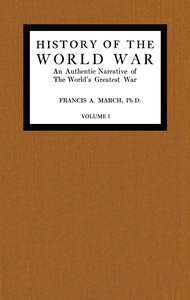
The source record for History of the World War, Volume 1 (of 7) — Context and Discussion measures this digital text at 44,163 words, 3 hr 13 min estimated reading time, and 18 detected text sections.
The text analysis averages about 21.8 words per sentence, while the detected sections provide another way to judge how the source is divided.
Project Gutenberg metadata also associates the work with “World War, 1914-1918,” connecting these edition facts with the source record’s subject description.
Explore this collection
These alternatives are selected using recorded categories and estimated reading time.
About 197 minutes
World Events
45,262 recorded words. 4 minutes difference from this book's estimate.
View Gutenberg source #36885About 180 minutes
World Events
41,174 recorded words. 13 minutes difference from this book's estimate.
View Gutenberg source #35724About 175 minutes
World Events
40,236 recorded words. 18 minutes difference from this book's estimate.
View Gutenberg source #74728Search stored excerpts and compare books → Choose by your preferences →
Choices use stored catalog measurements. Estimates vary with reading speed. A shared category is a catalog label, not a claim that two books have the same argument or literary quality.
Search reads excerpt text stored with this catalog and links to its associated Gutenberg record. The connection is stored in the site database; this tool does not recheck that every excerpt is word-for-word identical to that external record. Excerpt search does not cover every chapter and does not verify historical publication dates.
Catalog snapshot checked: 2026-09-25. Coverage: 95 public books, 95 available source excerpts.
Read the complete public-domain text at its original source.
Read on Project GutenbergThis volume opens with a list of victorious generals—Foch, Pershing, Haig—before the narrative has even begun, signaling that the work is framed by the war's outcome. The introduction by General Peyton C. March, U.S. Chief of Staff, emphasizes the need for an orderly compilation of facts, free from speculative conclusions. Yet the excerpt on Louvain reveals a text that juxtaposes official statements with graphic testimony, creating a tension between the promise of dispassionate record and the charged language of atrocity reporting.
The front matter establishes a hierarchy of credibility. The title page names Francis A. March, Ph.D., as author, in collaboration with war correspondent Richard J. Beamish, and boasts exclusive photographs by James H. Hare and Donald Thompson. The introduction by General March lends military imprimatur. This layering—academic, journalistic, official—suggests the work aims to be both authoritative and accessible. The excerpt, however, complicates this: the Louvain account is presented as a direct report from Minister Brand Whitlock, a diplomatic source, not the authors' own prose. The narrative voice recedes, letting the document speak, which implies a deliberate choice to let evidence stand without overt editorializing.
The Louvain section presents two conflicting versions of the same event. The first, attributed to Belgian authorities, describes a premeditated destruction: German troops, after a mistaken fusillade, pretended Belgians had fired, then systematically burned the town, including the university and Church of St. Pierre. The second, from Minister Whitlock, offers granular detail: German soldiers used incendiary pastils and petroleum sprayers, shot inhabitants fleeing their homes, and took hostages. A German surgeon is quoted saying, “The blood of the entire population of Louvain is not worth a drop of the blood of a German soldier.” The juxtaposition of these accounts, without explicit resolution, forces the reader to weigh the evidence.
The language in the Louvain report is deliberately emotive. Phrases like “heap of ashes,” “outrage on the rights of humanity,” and “unprecedented in history” frame the destruction as a moral violation. The text invokes shared values: Americans who studied at Louvain “cannot remain insensible.” This appeal to a transnational civilized community contrasts with the clinical tone of the introduction. The work thus oscillates between two registers: the detached compilation of facts and the impassioned indictment. Readers should note how the narrative uses official documents not as neutral records but as rhetorical tools, embedding judgment within quotation marks.
Although the excerpt does not include photographs, the title page prominently credits James H. Hare and Donald Thompson as “World-Famed War Photographers.” The inclusion of their work alongside government photographs suggests that visual evidence is integral to the volume's claim to authenticity. In an era before widespread newsreels, such images would have provided a powerful counterpoint to text, offering what contemporaries considered unmediated reality. The reader should consider how the written accounts of Louvain might interact with the photographs elsewhere in the volume—whether they corroborate, complicate, or overshadow the narrative.
This volume presents itself as a definitive record, yet its methods reveal the challenges of writing history amid ongoing conflict. The reader is advised to attend to the framing devices—the list of generals, the introduction, the attribution of sources—as much as to the events described. The work is not a neutral chronicle but a document shaped by its moment, reflecting both the desire for accuracy and the pressures of propaganda.
I remember, in the stillness after reading of Louvain’s ashes, a quieter thought about the men who would answer such devastation. The faces in that old volume felt less like generals and more like solemn witnesses to a burden they could not have imagined. It sits nearby, Generals of the British Army Portraits in Colour with Introductory and Biographical Notes — Reading Companion, a gentler echo of that same awful year, waiting for the light to fall just right.
Save your reaction, strongest insight, and memorable passage.