About 232 minutes
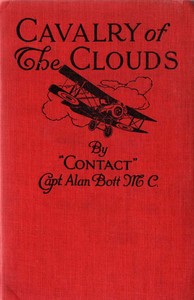
Cavalry of the Clouds — Reading Companion
World Events
53,242 recorded words. 4 minutes difference from this book's estimate.
View Gutenberg source #31211

Before opening Towards the Goal — Reading Companion, the edition data offers a quick orientation: 54,235 words, 3 hr 56 min estimated reading time, and 5 detected text sections.
The text analysis averages about 21.6 words per sentence, while the detected sections provide another way to judge how the source is divided.
Project Gutenberg metadata also associates the work with “World War, 1914-1918 -- Personal narratives,” connecting these edition facts with the source record’s subject description.
Explore this collection
These alternatives are selected using recorded categories and estimated reading time.
About 232 minutes
World Events
53,242 recorded words. 4 minutes difference from this book's estimate.
View Gutenberg source #31211About 230 minutes
World Events
52,743 recorded words. 6 minutes difference from this book's estimate.
View Gutenberg source #9650About 260 minutes
World Events
59,677 recorded words. 24 minutes difference from this book's estimate.
View Gutenberg source #39072Search stored excerpts and compare books → Choose by your preferences →
Choices use stored catalog measurements. Estimates vary with reading speed. A shared category is a catalog label, not a claim that two books have the same argument or literary quality.
Search reads excerpt text stored with this catalog and links to its associated Gutenberg record. The connection is stored in the site database; this tool does not recheck that every excerpt is word-for-word identical to that external record. Excerpt search does not cover every chapter and does not verify historical publication dates.
Catalog snapshot checked: 2026-09-25. Coverage: 95 public books, 95 available source excerpts.
Read the complete public-domain text at its original source.
Read on Project GutenbergMrs. Humphry Ward's Towards the Goal (1917) is structured as a sequence of letters addressed to Theodore Roosevelt, who also contributes an introduction. The book moves between British and French sectors of the Western Front, with a deliberate shift in focus announced midway: from describing the British military effort to documenting German devastation in France. Ward frames this transition around three words—'Reparation—Restitution—Guarantees'—which recur as a thematic anchor.
The narrative is built from specific, dated observations: a Flight-Commander's prediction before the Battle of Arras, the growing reliance on aeroplanes for artillery observation, and the quiet night in a village before travel to Lorraine. These details ground the work in a particular moment of the war, early 1917, before the German retreat and the worst devastations she later describes.
The book's structure follows Ward's physical journey. She begins with the British line, then announces a turn toward France, moving from the 'pleasant land of France' to the ruined villages of Lorraine. This movement is not merely geographical; it mirrors a shift in purpose. The opening letters emphasize the British effort—the 'huge development' of military machinery, the precision of artillery guided by aeroplanes. Later, the focus narrows to specific sites of destruction, such as Senlis and the battlefields of the Ourcq. Ward presents herself as a 'woman-witness' whose impressions are deliberately 'crowding,' suggesting an accumulation of scenes rather than a systematic analysis.
Aeroplanes appear repeatedly as symbols of protection and technological progress. Ward quotes a Flight-Commander's prediction that 'when the great move begins we shall get the mastery again, as we did on the Somme.' She notes that 'flying forms in the upper air become for the soldier below so many symbols of help and protection,' and that soldiers are 'restless when they are not there.' The text also provides a historical marker: aeroplanes were first used for artillery observation 'not three years ago, in the battle of Aisne.' These details tie the air war to the ground war, emphasizing coordination over individual heroism.
Ward explicitly states her second object: to make readers 'realise—as acutely and poignantly as I could—what it is we are really fighting for.' She lists German 'sufferings, outrages, and devastations' inflicted on France, and insists that Germany 'must be made to suffer and pay.' The phrase 'Reparation—Restitution—Guarantees' is repeated as a refrain. However, the excerpts show that her planned visits to Soissons, Reims, and Verdun were cancelled due to active operations; she instead visited Nancy and Lorraine. This gap between intention and execution is acknowledged, limiting the scope of her firsthand evidence to the eastern frontier rather than the most famous battlefields.
The book is dedicated to André Chevillon, described as 'True Son of France, True Friend of England,' which underscores the Anglo-French alliance at its core. Roosevelt's introduction frames the war as a struggle between 'free peoples' and 'tyrannous militarism,' and draws explicit parallels to American failings—'folly and selfishness and greed and soft slackness.' He praises England's 'awakening of the national soul.' This framing positions Ward's account as both a report and a moral lesson, intended to stir readers in Britain and America. The dedication and introduction together establish the book's dual audience and its propagandistic purpose.
Readers should approach Towards the Goal as a document shaped by its moment—early 1917, before American entry into the war, when the outcome was uncertain. Ward's letters are neither neutral nor comprehensive; they are deliberately persuasive, blending eyewitness detail with political argument. The book's value lies in its specific observations of technology, morale, and landscape, rather than in strategic analysis. Pay attention to the dates and locations she names, as they mark the limits of her direct experience.
I keep thinking about those letters from the Front—how the mud and the quiet determination stayed with her long after the guns fell still. There’s a weight to witnessing, a sort of ache that lingers. That same feeling came back when I found History of the World War, Volume 4 (of 7) — Edition Insights, its slow telling of what war does to a landscape and a people. It felt like remembering something I never saw.
Your answers remain private and are stored only in this browser.