About 87 minutes
With Botha in the Field — A Reader’s Guide
World Events
19,937 recorded words. 2 minutes difference from this book's estimate.
View Gutenberg source #15802
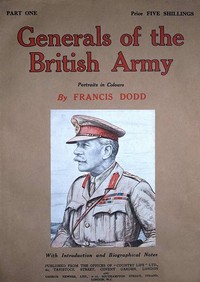
The catalog record for Generals of the British Army Portraits in Colour with Introductory and Biographical Notes — Reading Companion provides practical reading context through 20,365 words, 1 hr 29 min estimated reading time, and 3 detected text sections.
The text analysis averages about 19.8 words per sentence, while the detected sections provide another way to judge how the source is divided.
Project Gutenberg metadata also associates the work with “Generals -- Great Britain,” connecting these edition facts with the source record’s subject description.
Explore this collection
These alternatives are selected using recorded categories and estimated reading time.
About 87 minutes
World Events
19,937 recorded words. 2 minutes difference from this book's estimate.
View Gutenberg source #15802About 102 minutes
World Events
23,241 recorded words. 13 minutes difference from this book's estimate.
View Gutenberg source #24368About 69 minutes
World Events
15,659 recorded words. 20 minutes difference from this book's estimate.
View Gutenberg source #41272Search stored excerpts and compare books → Choose by your preferences →
Choices use stored catalog measurements. Estimates vary with reading speed. A shared category is a catalog label, not a claim that two books have the same argument or literary quality.
Search reads excerpt text stored with this catalog and links to its associated Gutenberg record. The connection is stored in the site database; this tool does not recheck that every excerpt is word-for-word identical to that external record. Excerpt search does not cover every chapter and does not verify historical publication dates.
Catalog snapshot checked: 2026-09-25. Coverage: 95 public books, 95 available source excerpts.
Read the complete public-domain text at its original source.
Read on Project GutenbergFrancis Dodd's Generals of the British Army is a portrait gallery published in 1917, pairing colour plates with biographical notes. The book's two introductions frame the generals not as remote commanders but as men who 'first had to struggle against heavy odds' before leading large forces. Dodd stresses the tiny size of the original British Expeditionary Force—'even the Belgian army was more numerous'—and the near-disasters of Mons and the retreat. The text repeatedly contrasts the 'small contingent' fighting for an ideal with the 'vast German horde' trained for speed. This is a wartime tribute, not a balanced history, and its language is often dramatic: the first four months are called 'the greatest ordeal of our history,' and the generals' story is 'memorably fine.'
The book is divided into two portrait galleries, each with its own introduction. The first features twelve generals including Haig, Plumer, Rawlinson, and Allenby; the second adds twelve more, with Lord French as its 'central figure.' The introductions treat these as distinct phases of the war. Part I emphasises the early Western Front, where the British Army 'stood between the Allies and disaster.' Part II focuses on the first four months under French, calling that period 'unique' and noting that 'little of the first Army was left' after it. The structure suggests that the war's character changed fundamentally after the initial crisis, and that the generals of each phase faced different conditions.
Dodd's prose is charged with urgency. He describes the German advance as emerging 'from behind its concealing curtain of horse,' and writes that the British role was to 'outflank the German right wing'—a plan that seems impossible in hindsight. The text uses terms like 'fiery trial,' 'awful tryst,' and 'evil dream' to convey the stakes. Numbers are vague but evocative: 'a full half-million picked German troops' marched across Belgium, while the British force was a 'handful' that 'ought to have been crushed at Mons.' The emotional register is high, with phrases like 'the fire and inspiration of the generations to come.' This is not a dry reference work but a piece of war literature, aiming to memorialise its subjects.
The catalog lists this under 'World War, 1914-1918 -- Biography' and 'Generals -- Great Britain,' but the excerpts reveal a narrower focus. The book does not attempt comprehensive biographies; it offers short notes alongside portraits, and the introductions dwell almost entirely on 1914. There is no mention of later battles like the Somme or Passchendaele, nor of strategy beyond the first months. The tone is celebratory and defensive, arguing that the generals' achievement was to hold on against impossible odds. Readers expecting a full operational history will find instead a commemorative sketchbook, heavy on atmosphere and light on detail. The portraits themselves are not described in the text, but the emphasis on colour plates suggests a visual as well as textual tribute.
Because the excerpts are limited to the introductions and table of contents, the biographical notes themselves are not represented here. Readers should approach the book as a contemporary artifact—a morale-boosting publication from 1917—rather than a detached historical account. The portraits and notes likely reinforce the heroic narrative sketched in the introductions. For those interested in how the British high command was presented to the public during the war, this volume offers a concentrated example of official admiration and emotional rhetoric.
The rain drummed on the windows while I pored over Francis Dodd’s stern portraits, struck by how few those British generals had to command in 1914. That haunting scarcity made me wonder about the other front, the one stretching vast and immense. I found myself reaching for Russia's Part in the World War — Reading Companion, and the afternoon deepened quietly from there.
Your answers remain private and are stored only in this browser.