About 230 minutes
Independent Bohemia An Account of the Czecho-Slovak Struggle for Liberty — Reading Notes
World Events
52,743 recorded words. 2 minutes difference from this book's estimate.
View Gutenberg source #9650
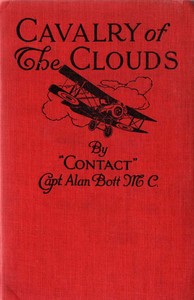
The catalog record for Cavalry of the Clouds — Reading Companion provides practical reading context through 53,242 words, 3 hr 52 min estimated reading time, and 7 detected text sections.
The text analysis averages about 20.4 words per sentence, while the detected sections provide another way to judge how the source is divided.
Project Gutenberg metadata also associates the work with “Aeronautics, Military,” connecting these edition facts with the source record’s subject description.
Explore this collection
These alternatives are selected using recorded categories and estimated reading time.
About 230 minutes
World Events
52,743 recorded words. 2 minutes difference from this book's estimate.
View Gutenberg source #9650About 236 minutes
World Events
54,235 recorded words. 4 minutes difference from this book's estimate.
View Gutenberg source #10099About 260 minutes
World Events
59,677 recorded words. 28 minutes difference from this book's estimate.
View Gutenberg source #39072Search stored excerpts and compare books → Choose by your preferences →
Choices use stored catalog measurements. Estimates vary with reading speed. A shared category is a catalog label, not a claim that two books have the same argument or literary quality.
Search reads excerpt text stored with this catalog and links to its associated Gutenberg record. The connection is stored in the site database; this tool does not recheck that every excerpt is word-for-word identical to that external record. Excerpt search does not cover every chapter and does not verify historical publication dates.
Catalog snapshot checked: 2026-09-25. Coverage: 95 public books, 95 available source excerpts.
Read the complete public-domain text at its original source.
Read on Project GutenbergAlan Bott, writing under the pseudonym "Contact," structures his account of the Royal Flying Corps not as a continuous narrative but as a series of discrete episodes, each built around a specific flight or mission. The excerpts show a pattern: the observer's task (counting trains, mapping troop movements) is repeatedly interrupted by anti-aircraft fire—"Archie"—forcing him to withdraw into "the office" (the cockpit). This rhythmic alternation between duty and survival shapes the reader's experience of aerial reconnaissance as a contest between meticulous observation and chaotic threat.
The excerpts reveal that the observer's primary duty—gathering intelligence—is constantly at odds with self-preservation. Bott describes leaning over to count stationary trucks, only to be driven back by the "wouff, wouff, wouff" of bursting shells. He makes repeated attempts: "Again I put my head in the office." The work is never cleanly completed; estimates replace precise counts. This tension between the need for accuracy and the instinct to duck is a recurring structural element, not a one-time event. The text does not claim that every mission ends in success; rather, it emphasizes the process of partial, interrupted observation under fire.
Bott's prose frequently tracks the machine's vertical and horizontal shifts. After a near-hit lifts the aircraft "about a hundred feet," the crew "nose into the clouds" to escape. Later, they descend through a gap to observe Boislens. These movements are not merely scenic; they are tactical decisions. The clouds serve as both refuge and obstacle. The text notes that the wind accelerates ground speed to "about a hundred and fifty miles an hour" on the homeward leg, a detail that grounds the reader in the physics of flight. The structure of each episode often follows a pattern: approach, observation under fire, evasion via cloud, and return.
A recurring motif in the excerpts is the pilot's vigilance toward the sun. Bott writes that he "look[s] closely toward the sun—for a fast scout will often try to surprise a two-seater by approaching between its quarry and the sun." He describes the gradual recognition of an "indistinct oblong object" that becomes a hostile aircraft. This detail is not merely atmospheric; it is a specific tactical warning. The text shows that the sun is both a source of glare and a potential hiding place for enemies. The observer's gaze must constantly shift between the ground below and the sky above, a dual focus that defines the work's visual structure.
Bott uses colloquial terms like "wind up" (anxiety) and "the office" to convey the psychological state of the crew. After a particularly close shell, he writes, "That finishes my observation work for the moment. Not with a court-martial as the only alternative could I carry on." The humor is dry, but the admission of fear is direct. The text does not glorify the pilots as fearless; instead, it shows them managing fear through routine and dark jokes. The structure of the narrative—alternating between intense action and lulls—mirrors the emotional rhythm of combat flying. The reader is left with a sense of the constant, low-grade dread punctuated by moments of acute danger.
Readers should pay attention to how Bott uses the physical environment—clouds, sun, wind—as both setting and active participant in the mission. The book's episodic structure means that each chapter can be read as a self-contained sortie, but together they build a cumulative portrait of the observer's war. The absence of a grand plot is itself a statement: for the Flying Corps, survival and duty were the only narratives that mattered.
Reading about the pilot's lonely watch above the trenches, I remembered my grandfather’s quiet collection of war diaries. He never spoke of the sea, yet Our Navy in the War — Reading Notes gave me that same feeling of vast, patient waiting. Both books whisper about duty done far from home, in the cold and the silence.
A brief reflection can help important ideas stay with you longer.