About 175 minutes
History of the World War, Volume 4 (of 7) — Edition Insights
World Events
40,236 recorded words. 5 minutes difference from this book's estimate.
View Gutenberg source #74728
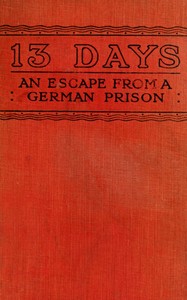
This digital edition of 13 Days: The Chronicle of an Escape from a German Prison — Inside the Classic is described by source-level measurements including 41,174 words, 3 hr estimated reading time, and 5 detected text sections.
The text analysis averages about 22.6 words per sentence, while the detected sections provide another way to judge how the source is divided.
Project Gutenberg metadata also associates the work with “World War, 1914-1918 -- Prisoners and prisons, German,” connecting these edition facts with the source record’s subject description.
Explore this collection
These alternatives are selected using recorded categories and estimated reading time.
About 175 minutes
World Events
40,236 recorded words. 5 minutes difference from this book's estimate.
View Gutenberg source #74728About 193 minutes
World Events
44,163 recorded words. 13 minutes difference from this book's estimate.
View Gutenberg source #74726About 197 minutes
World Events
45,262 recorded words. 17 minutes difference from this book's estimate.
View Gutenberg source #36885Search stored excerpts and compare books → Choose by your preferences →
Choices use stored catalog measurements. Estimates vary with reading speed. A shared category is a catalog label, not a claim that two books have the same argument or literary quality.
Search reads excerpt text stored with this catalog and links to its associated Gutenberg record. The connection is stored in the site database; this tool does not recheck that every excerpt is word-for-word identical to that external record. Excerpt search does not cover every chapter and does not verify historical publication dates.
Catalog snapshot checked: 2026-09-25. Coverage: 95 public books, 95 available source excerpts.
Read the complete public-domain text at its original source.
Read on Project GutenbergCaptain J.A.L. Caunter’s narrative opens not with a dramatic breakout but with a deliberate, almost bureaucratic preface: he states two supplementary objects for writing—to document prisoner treatment and to illuminate the prisoners’ spirit. This framing sets a tone of measured purpose, even as the text soon plunges into the raw specifics of evasion. The account is structured as a chronicle, with dated entries (e.g., “Thursday, 21st June”) that lend a diaristic immediacy. Caunter’s voice is precise and self-deprecating; he notes his own errors, such as nearly walking into two men in the dawn light, and admits to feeling “inclined to roar with laughter” after outwitting an ambush. The prose balances tactical detail—rubber-soled shoes, light coffee-tinted clothes—with the psychological weight of constant vigilance.
The excerpt from the bridge crossing reveals Caunter’s methodical approach to danger. He describes an ambush placed not on the bridge itself but fifty to sixty yards away, a cunning trap for anyone who “straining his eyes eagerly forward” checks only the bridge ends. Caunter’s response is to wait—four hours, bitten by mosquitoes, listening for coughs in the dark. He crawls on all-fours, feeling for dead sticks, and moves only when he judges the guards less alert. This patience is a recurring pattern: he tires the enemy out rather than rushing. The episode also highlights his awareness of visibility: he notes that his light coffee clothes “assimilated very well” with the dusty road and white bridge woodwork, a small but telling detail of his adaptive camouflage.
Caunter’s escape is as much a negotiation with terrain as with German patrols. Rivers, bridges, roads, and bushes are described with tactical precision: the embankment, the sky-line, the cover of trees bordering country roads. He uses the environment to hide, but it also betrays him—dead sticks crack, bushes rustle. The narrative repeatedly notes how natural features become obstacles or opportunities. For instance, after crossing the bridge, he walks through a village “without even causing a dog to bark,” a small victory of silence. Yet the landscape also imposes physical costs: mosquitoes, sleep deprivation, and the constant need to read the ground. Caunter’s eye for detail—the “white painted woodwork” of the bridge, the “light coffee tint” of his clothes—turns the setting into a character in its own right, one that must be outmaneuvered as much as the human pursuers.
Beyond the physical challenges, Caunter’s account reveals the mental strain of prolonged evasion. He admits to near-mistakes born of sleepiness: “I was sleepy I suppose and was not so sharp on the look-out.” The ambush scene is a study in controlled fear—he waits four hours, knowing men are nearby, and then crawls with “very cautious” movements. The relief after crossing the bridge is palpable: he feels like laughing and wants to shout insults, but instead continues quietly. This restraint is a form of self-discipline that pervades the narrative. Caunter also reflects on the broader prisoner experience, quoting a fellow officer’s poem about “this filthiest backwater of time’s flow” and the fight against “barbed-wire disease.” The escape is not just a physical journey but a battle against despair, where hope and energy must be deliberately maintained.
Readers should approach 13 Days as a document of applied patience and acute observation rather than a thriller. Caunter’s strength lies in the granular: the feel of dead sticks under his hands, the color of his clothes against the road, the cough of a hidden guard. The narrative rewards attention to these details, which accumulate into a portrait of survival through methodical caution. The incomplete excerpts leave the full route and outcome unknown, but the texture of the journey—its waiting, its small triumphs, its unglamorous endurance—is already vivid.
There’s a particular loneliness in Caunter’s careful counting of bridges and rivers—every landmark a possible end. It reminds me of another quiet ordeal, a soldier’s long walk through Poland, where the landscape itself seems to hold its breath. Both are stories of moving forward without certainty. I keep thinking about that. In the Russian Ranks: A Soldier's Account of the Fighting in Poland — Inside the Classic stays with me the same way, a low, steady hum in the back of the mind.
Answer a few questions and save a private reflection on this device.