About 306 minutes
With the Judæans in the Palestine Campaign — Reading Companion
World Events
70,302 recorded words. 15 minutes difference from this book's estimate.
View Gutenberg source #41848
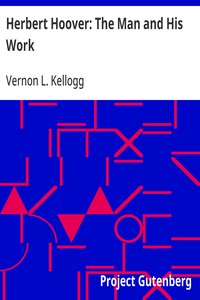
The catalog record for Herbert Hoover: The Man and His Work — Story, Setting & Ideas provides practical reading context through 73,626 words, 5 hr 21 min estimated reading time, and 8 detected text sections.
The text analysis averages about 25.4 words per sentence, while the detected sections provide another way to judge how the source is divided.
Project Gutenberg metadata also associates the work with “Hoover, Herbert, 1874-1964,” connecting these edition facts with the source record’s subject description.
Explore this collection
These alternatives are selected using recorded categories and estimated reading time.
About 306 minutes
World Events
70,302 recorded words. 15 minutes difference from this book's estimate.
View Gutenberg source #41848About 291 minutes
World Events
66,772 recorded words. 30 minutes difference from this book's estimate.
View Gutenberg source #34188About 290 minutes
World Events
66,557 recorded words. 31 minutes difference from this book's estimate.
View Gutenberg source #18676Search stored excerpts and compare books → Choose by your preferences →
Choices use stored catalog measurements. Estimates vary with reading speed. A shared category is a catalog label, not a claim that two books have the same argument or literary quality.
Search reads excerpt text stored with this catalog and links to its associated Gutenberg record. The connection is stored in the site database; this tool does not recheck that every excerpt is word-for-word identical to that external record. Excerpt search does not cover every chapter and does not verify historical publication dates.
Catalog snapshot checked: 2026-09-25. Coverage: 95 public books, 95 available source excerpts.
Read the complete public-domain text at its original source.
Read on Project GutenbergVernon Kellogg, who served alongside Herbert Hoover in the Commission for Relief in Belgium, opens his 1920 biography not with Hoover's birth but with a scene in Warsaw: 'It was a great day for the children of Warsaw.' The author immediately establishes his firsthand vantage point, describing himself in the preface as 'an observer, associate and friend.' This dual role shapes the narrative, blending personal testimony with documentary intent.
The catalog subjects—Hoover and World War I food supply—accurately reflect the book's core, but the excerpts reveal a narrower focus: Hoover's administrative philosophy, particularly his reliance on 'voluntary response' over government regulation. Kellogg contrasts Hoover's approach with European food controllers, emphasizing 'direct appeal to the people.' The biography is less a full life story than a case study in wartime logistics and democratic persuasion.
Kellogg declares his aim in the preface: to tell 'simply and straightforwardly, the personal story of the man and his work up to the present.' The word 'personal' is key, as the excerpts show Kellogg inserting himself into the narrative. He recalls a group of grain dealers who came to Washington 'with big sticks' to confront Hoover, only to be won over after conferences. The author was present: 'I remember a group of large buyers and sellers of grain.' This eyewitness stance lends credibility but also limits the scope—Kellogg can only report what he saw or was told.
The dedication 'to my companions of the C. R. B.' further signals the book's origin in a specific community. Readers should note that the biography was published in 1920, before Hoover's presidency, and thus covers only his early life and wartime service. The author's friendship with Hoover may color the portrayal; Kellogg does not hide his admiration, calling Hoover 'conspicuously effective in public service.'
A recurring theme in the excerpts is Hoover's insistence on voluntary compliance. Kellogg writes that Hoover 'depended on the reasoned mass consent and action of the nation.' He refused to be a 'food dictator' like the German minister or even a 'food controller' like the English official; instead, he styled himself a 'food administrator.' The method involved holding conferences with trade groups, explaining needs, and 'lay[ing] all his cards on the table.'
The excerpts illustrate this with the anecdote of the grain dealers and the cartoon of 'black Matilda' resisting advice on cornbread. Kellogg presents Hoover's approach as uniquely American, rooted in 'the genius of American people.' Yet the text also acknowledges resistance: 'the news that ran swiftly over the country ... was not always the truth, but it always got listened to.' The biography thus documents both the ideal and the friction of Hoover's voluntary system.
The table of contents shows a chronological structure: from Hoover's childhood and university years through his mining career in China and around the world, then to the war. However, the excerpts provided skip the early chapters entirely, jumping to the Warsaw scene and the Food Administration. This imbalance means the reader of this digital edition gets a skewed view—heavy on wartime administration, light on personal background.
Kellogg's prose is straightforward, with little embellishment. He uses concrete details: the grain dealers 'came with big sticks,' Hoover 'put the matter of food control fairly and squarely up to the people.' The book includes appendices, suggesting documentary support. But the excerpts do not reveal how Kellogg handles Hoover's mining career or his time in China. Readers should be aware that the full text likely offers a broader portrait than the excerpts suggest, though always filtered through Kellogg's admiring lens.
Kellogg's biography is best approached as a contemporary account by a participant-observer, not as a definitive or critical history. Readers interested in Hoover's later presidency or his full life story will need to supplement this volume with later works. The book's value lies in its detailed depiction of wartime food administration and the philosophy of voluntary cooperation—a perspective that shaped Hoover's public image before the White House years.
I remember how Kellogg’s Hoover story felt like watching a man organize mercy against chaos, one careful ledger at a time. There is a similar quiet in The Adventures of the U-202: An Actual Narrative — Text and Context, where the sea itself becomes a kind of ledger of endurance. Both books whisper of method amid danger.
Create a short personal record of your experience with this book.