About 193 minutes
History of the World War, Volume 1 (of 7) — Context and Discussion
World Events
44,163 recorded words. 4 minutes difference from this book's estimate.
View Gutenberg source #74726
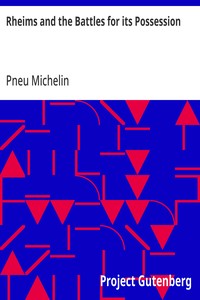
Before opening Rheims and the Battles for its Possession — Key Ideas to Explore, the edition data offers a quick orientation: 45,262 words, 3 hr 17 min estimated reading time, and 9 detected text sections.
The text analysis averages about 16.9 words per sentence, while the detected sections provide another way to judge how the source is divided.
Project Gutenberg metadata also associates the work with “World War, 1914-1918 -- Battlefields -- Guidebooks,” connecting these edition facts with the source record’s subject description.
Explore this collection
These alternatives are selected using recorded categories and estimated reading time.
About 193 minutes
World Events
44,163 recorded words. 4 minutes difference from this book's estimate.
View Gutenberg source #74726About 180 minutes
World Events
41,174 recorded words. 17 minutes difference from this book's estimate.
View Gutenberg source #35724About 175 minutes
World Events
40,236 recorded words. 22 minutes difference from this book's estimate.
View Gutenberg source #74728Search stored excerpts and compare books → Choose by your preferences →
Choices use stored catalog measurements. Estimates vary with reading speed. A shared category is a catalog label, not a claim that two books have the same argument or literary quality.
Search reads excerpt text stored with this catalog and links to its associated Gutenberg record. The connection is stored in the site database; this tool does not recheck that every excerpt is word-for-word identical to that external record. Excerpt search does not cover every chapter and does not verify historical publication dates.
Catalog snapshot checked: 2026-09-25. Coverage: 95 public books, 95 available source excerpts.
Read the complete public-domain text at its original source.
Read on Project GutenbergThe guidebook opens with a walking route through Rheims, directing the reader to turn into the Rue des Fusiliers, cross the Place du Parvis, and follow the Rue Tronson Ducoudray. Its language is terse and procedural: “Take the Rue St. Just on the right, and follow its continuation.” Yet this neutral tone is repeatedly broken by parenthetical damage reports. The Rue de Talleyrand, we are told, “was destroyed by fire during the bombardments of April, 1918.” The Rue Carnot, too, is “destroyed by the bombardments of April, 1918.” The guidebook’s voice oscillates between that of a detached cartographer and a witness to erasure.
The narrative voice shifts abruptly between the practical and the commemorative. The opening pages include a full-page advertisement for Michelin maps, then a subscription pitch for the Touring Club de France, then a list of employees who “died gloriously for their country.” The guidebook itself then adopts the clipped, imperative style of a route description: “Turn into the first street on the right.” But when it reaches the Palais de Justice, the tone turns evaluative: the building is “of little note, the principal entrance in particular being stiff to excess.” This blend of military precision and aesthetic judgment creates a distinctive hybrid—part field manual, part architectural critique.
The guidebook’s rhythm is built on a pattern of instruction then interruption. A typical passage directs the reader along a street, then adds a parenthetical note of destruction. The Rue de la Clef leads to the Place du Palais, “destroyed during the bombardments of April, 1918.” The Rue Carnot is similarly described. These interruptions are brief, often a single clause, but they accumulate. The reader’s imagined progress through the city is constantly halted by reminders of what is no longer there. The effect is a walking tour that becomes a catalogue of loss, with the pace of the prose mirroring the staccato of shellfire.
Certain details recur with insistence: the date “April, 1918,” the phrase “destroyed by fire,” and the mention of “interesting old houses” that were destroyed. The guidebook notes that the Rue de Talleyrand “suffered further damage in the months that followed.” It records the fate of the Hôtel de Bezannes, now in ruins, and the Chapter-House gate, whose “points of the turrets have disappeared, a supporting shaft has been mutilated.” These observations are precise and unembellished. The guidebook does not lament; it inventories. The repetition of such details across different streets creates a cumulative portrait of a city systematically unmade.
Readers should attend to the guidebook’s dual function: it is both a practical itinerary and a document of erasure. The walking directions remain usable, but the damage reports transform each turn into an encounter with absence. The guidebook’s value lies not in its completeness—the excerpts offer only fragments—but in its method of recording what was lost, street by street, without sentimentality.
That 1919 guidebook to Rheims walks us past vanished stone, counting each fractured arch like a held breath. There is a strange kinship I feel with Cavalry of the Clouds — Reading Companion, whose pilots likewise mapped a wounded sky. Both whisper of what was lost, cataloguing absence tenderly, so we might remember it whole.
Your answers remain private and are stored only in this browser.