About 321 minutes
Herbert Hoover: The Man and His Work — Story, Setting & Ideas
World Events
73,626 recorded words. 15 minutes difference from this book's estimate.
View Gutenberg source #29489
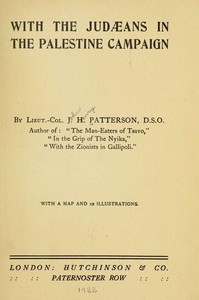
Before opening With the Judæans in the Palestine Campaign — Reading Companion, the edition data offers a quick orientation: 70,302 words, 5 hr 6 min estimated reading time, and 9 detected text sections.
The text analysis averages about 26.5 words per sentence, while the detected sections provide another way to judge how the source is divided.
Project Gutenberg metadata also associates the work with “World War, 1914-1918 -- Campaigns -- Palestine,” connecting these edition facts with the source record’s subject description.
Explore this collection
These alternatives are selected using recorded categories and estimated reading time.
About 321 minutes
World Events
73,626 recorded words. 15 minutes difference from this book's estimate.
View Gutenberg source #29489About 291 minutes
World Events
66,772 recorded words. 15 minutes difference from this book's estimate.
View Gutenberg source #34188About 290 minutes
World Events
66,557 recorded words. 16 minutes difference from this book's estimate.
View Gutenberg source #18676Search stored excerpts and compare books → Choose by your preferences →
Choices use stored catalog measurements. Estimates vary with reading speed. A shared category is a catalog label, not a claim that two books have the same argument or literary quality.
Search reads excerpt text stored with this catalog and links to its associated Gutenberg record. The connection is stored in the site database; this tool does not recheck that every excerpt is word-for-word identical to that external record. Excerpt search does not cover every chapter and does not verify historical publication dates.
Catalog snapshot checked: 2026-09-25. Coverage: 95 public books, 95 available source excerpts.
Read the complete public-domain text at its original source.
Read on Project GutenbergColonel J. H. Patterson, who previously led the Zionists at Gallipoli, commanded a unique Jewish Battalion in the British Army during the Palestine Campaign. His narrative, published in 1922, combines detailed accounts of military operations with reflections on the biblical landscape. The excerpts show Patterson describing the capture of Es Salt and Amman, noting the Roman amphitheater at Amman and quoting Ezekiel about Rabbah becoming a stable for camels. He also records a fatal accident with a dud aerial bomb and comments on the lack of a war correspondent for Chaytor's Force. The catalog subjects—World War I campaigns in Palestine and Jewish participation—are directly addressed, but the text also reveals Patterson's interest in archaeology, local populations like Circassians, and the strategic value of the region.
Patterson frequently links his surroundings to scripture. At Amman, he observes that Ezekiel's prophecy about Rabbah becoming a stable for camels was "literally fulfilled." He describes the Roman amphitheater, once filled with roaring crowds, now silent except for bats and owls. He speculates on whether the ancient citadel is the one that resisted Joab. These observations blend military reportage with a pilgrim's eye, grounding the campaign in a deeper historical and religious context. The author does not claim expertise; he admits uncertainty about the citadel's origin. This habit of connecting present events to biblical text is a recurring structural feature.
The preface states that forming a Jewish Battalion was "an event without precedent in our annals." Patterson emphasizes that the unit fought not only for Britain but also for the "Restoration of the Jewish people to the Promised Land." The excerpts show him noting the Balfour Declaration (chapter I) and addressing the "Kosher Problem" (chapter V). However, the provided text does not detail the battalion's daily life or internal dynamics. Patterson's perspective is that of a commanding officer, proud of his men but focused on operations. The catalog subject "World War, 1914-1918 -- Participation, Jewish" is clearly relevant, but the excerpts reveal little about the soldiers' own voices or experiences.
Patterson provides specific tactical details: Chaytor's Force covered 60 miles in four days, captured 11,000 prisoners and 60 guns, and did so without a single sabre or lance—the Anzacs relied on "man, horse, and rifle." He notes the difficulty of fighting in the hills of Moab and the treacherous behavior of Circassians during previous raids. The narrative includes mundane details like the loss of transport wagons (chapter XVI) and a race at Bir Salem (chapter XXVII). These concrete observations ground the account in the physical realities of the campaign, though the excerpts do not reveal the broader strategic picture or the war's outcome.
Readers should approach this book as a personal memoir rather than a comprehensive history. Patterson's voice is authoritative but limited to his command and observations. The text offers a unique window into a little-known unit, but its perspective is that of a British officer, not the Jewish soldiers themselves. Those interested in the intersection of military history, biblical geography, and early Zionist aspirations will find much to consider, but should supplement with other sources for a fuller picture.
I remember shelving Patterson’s weary, hopeful account of Judæan soldiers marching through scripture-haunted hills. His quiet grit always reminded me of another war’s ledger—The A. E. F.: With General Pershing and the American Forces — Reading Notes—each a soldier’s measured step through foreign dust, carrying old words into new dawns. They sit apart, yet breathe as one in memory.
Build a private reading journal entry for this title.