About 290 minutes
Our Navy in the War — Reading Notes
World Events
66,557 recorded words. 1 minutes difference from this book's estimate.
View Gutenberg source #18676
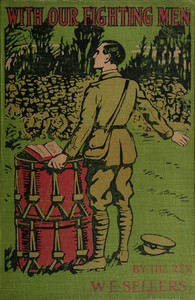
The source record for With Our Fighting Men The story of their faith, courage, endurance in the Great War — Themes and Context measures this digital text at 66,772 words, 4 hr 51 min estimated reading time, and 9 detected text sections.
The text analysis averages about 19.2 words per sentence, while the detected sections provide another way to judge how the source is divided.
Project Gutenberg metadata also associates the work with “Great Britain. Army -- Military life,” connecting these edition facts with the source record’s subject description.
Explore this collection
These alternatives are selected using recorded categories and estimated reading time.
About 290 minutes
World Events
66,557 recorded words. 1 minutes difference from this book's estimate.
View Gutenberg source #18676About 306 minutes
World Events
70,302 recorded words. 15 minutes difference from this book's estimate.
View Gutenberg source #41848About 270 minutes
World Events
61,899 recorded words. 21 minutes difference from this book's estimate.
View Gutenberg source #36757Search stored excerpts and compare books → Choose by your preferences →
Choices use stored catalog measurements. Estimates vary with reading speed. A shared category is a catalog label, not a claim that two books have the same argument or literary quality.
Search reads excerpt text stored with this catalog and links to its associated Gutenberg record. The connection is stored in the site database; this tool does not recheck that every excerpt is word-for-word identical to that external record. Excerpt search does not cover every chapter and does not verify historical publication dates.
Catalog snapshot checked: 2026-09-25. Coverage: 95 public books, 95 available source excerpts.
Read the complete public-domain text at its original source.
Read on Project GutenbergWilliam E. Sellers' With Our Fighting Men (1915) is a wartime compilation that draws on letters, chaplains' reports, and newspaper extracts to depict the religious and moral life of British soldiers during the first year of the Great War. Rather than a continuous narrative, the book assembles vignettes—from home-front departures to trench services—often preserving the exact wording of soldiers' own accounts. The catalog subjects list 'Military life' and 'Religious aspects,' and the excerpts bear this out: the text is saturated with descriptions of hymn-singing, prayer meetings, and improvised communion, but also with the mundane details of trench routine and the unexpected fraternisation of the 1914 Christmas truce.
The longest sustained episode in the excerpts recounts the Christmas Day service conducted by the Rev. J. Esslemont Adams, a United Free Church chaplain attached to the Gordon Highlanders. Sellers pieces together the story from multiple reports sent to Scotland, then adds Adams' own brief comments. On Christmas morning, Adams visited the trenches and found that the Gordons had recently relieved the Scottish Borderers; several dead bodies of the Borderers lay between the lines. A German officer agreed to a truce for a burial service. The Germans lined up on one side of the chaplain, the Gordons on the other. The service began with the hymn 'The Lord is my Shepherd,' followed by a prayer and an address interpreted sentence by sentence. After the burial of about a hundred dead, the German officer shook hands with Adams and offered him a cigar. Adams kept it as a souvenir and gave the officer the Soldier's Prayer he had carried in his cap lining. The officer placed it in his helmet lining, saying he valued it because he believed what it said. Not a shot was fired that day or the next.
Sellers frequently reproduces letters and press clippings, often with minimal editorial comment. One officer's letter, cited from the Manchester Guardian, describes a friendly haircut: at 11 p.m. on Christmas Eve there was 'absolute peace, bar a little sniping,' then singing of 'The King,' and a shouted agreement not to fight. An officer met a Bavarian halfway between the lines, smoked a cigarette, and talked. Men fraternised, played football with a bully beef tin, and one soldier cut a German's hair. Sellers also quotes a soldier who wrote that some German officers took photographs of the men between the trenches, adding, 'I would not have missed the experience of yesterday for the most gorgeous Christmas dinner in England.' These embedded voices give the book a documentary texture, though the excerpts do not reveal how Sellers selected or verified his sources. The preface thanks editors of the Methodist Recorder, War Cry, and other periodicals, indicating the range of material drawn upon.
The book's table of contents shows twelve chapters moving from 'At the Home Base' to 'When the Men Come Home,' with intervening chapters on the fighting base, the Marne, Ypres, the trenches, Christmas, chaplains' work, and the Grand Fleet. The excerpts come from Chapter VI, 'Christmas at the Front,' and the preface. Sellers' own voice is most visible in the preface, where he thanks senior chaplains and board secretaries, and in transitional phrases such as 'I piece the story together from various reports' and 'I might multiply these extracts indefinitely.' He does not claim to have been an eyewitness; his role is compiler and arranger. The excerpts contain no analysis of strategy or politics, focusing instead on morale, faith, and the 'spirit' of the men. The catalog subject 'World War, 1914-1918 -- Religious aspects' accurately reflects the content, but the book also records secular details—football games, haircuts, souvenir exchanges—that go beyond a narrowly religious framing.
Readers approaching With Our Fighting Men should expect a mosaic of contemporary sources rather than a single authorial argument. The excerpts suggest that Sellers prioritises immediacy over analysis, letting soldiers and chaplains speak at length. The book's value lies in the raw material it preserves—letters, newspaper items, and official reports—from the first year of the war, before later censorship or retrospective myth-making reshaped the narrative. Those interested in the social history of religion in the trenches, or in the 1914 Christmas truce as recorded by participants, will find this a rich primary document.
Reading those chaplains’ letters, I kept thinking about the lull between the mud and the wire—that strange quiet where men found themselves glancing up. It reminded me of another kind of stillness, one I found later in Cavalry of the Clouds — Reading Companion, where the sky itself held its breath above the guns. Odd how those moments linger longest.
Your answers remain private and are stored only in this browser.