About 69 minutes
"Speaking of Prussians--" — Reading Notes
World Events
15,659 recorded words. 2 minutes difference from this book's estimate.
View Gutenberg source #41272
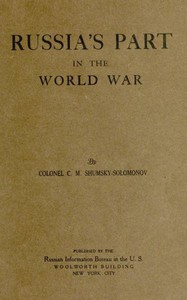
The source record for Russia's Part in the World War — Reading Companion measures this digital text at 15,357 words, 1 hr 7 min estimated reading time, and 2 detected text sections.
The text analysis averages about 26.5 words per sentence, while the detected sections provide another way to judge how the source is divided.
Project Gutenberg metadata also associates the work with “World War, 1914-1918 -- Soviet Union,” connecting these edition facts with the source record’s subject description.
Explore this collection
These alternatives are selected using recorded categories and estimated reading time.
About 69 minutes
World Events
15,659 recorded words. 2 minutes difference from this book's estimate.
View Gutenberg source #41272About 51 minutes
World Events
11,668 recorded words. 16 minutes difference from this book's estimate.
View Gutenberg source #37227About 87 minutes
World Events
19,937 recorded words. 20 minutes difference from this book's estimate.
View Gutenberg source #15802Search stored excerpts and compare books → Choose by your preferences →
Choices use stored catalog measurements. Estimates vary with reading speed. A shared category is a catalog label, not a claim that two books have the same argument or literary quality.
Search reads excerpt text stored with this catalog and links to its associated Gutenberg record. The connection is stored in the site database; this tool does not recheck that every excerpt is word-for-word identical to that external record. Excerpt search does not cover every chapter and does not verify historical publication dates.
Catalog snapshot checked: 2026-09-25. Coverage: 95 public books, 95 available source excerpts.
Read the complete public-domain text at its original source.
Read on Project GutenbergColonel C. M. Shumsky-Solomonov’s 1920 pamphlet opens with a blunt numerical claim: Russia’s 12,000,000 casualties, including 3,000,000 dead, are presented as more than twice those of France and four to five times those of England. The author, a Russian Army officer and former defender of Port Arthur, writes from a position of military authority, but the text functions as a political argument rather than a dispassionate history. The introduction frames Russia’s collapse into Bolshevism as a direct consequence of wartime exhaustion, a thesis that colors every subsequent paragraph. The prose is dense with figures and defensive in tone, repeatedly insisting that Russia’s sacrifices were decisive—especially in frustrating Germany’s initial plan to concentrate all forces against France. The pamphlet’s structure moves from general claims of importance to specific operational examples, then to casualty statistics, creating a cumulative rhetorical effect.
The pamphlet’s narrative voice is that of a soldier-advocate, not a detached historian. Shumsky-Solomonov uses first-person plural (“we”) and possessive constructions (“our front,” “our armies”) to align himself with the Russian military effort. The language is urgent and moralizing: Russia “did not hesitate for one minute” to aid allies, and her “honest Russia” remained true to obligations. The author frequently contrasts Russian self-sacrifice with allied hesitation, as when he notes that Roumanian officials declined Russian defense of Bucharest due to “political considerations.” The tone shifts between statistical recitation and emotional appeal, particularly in phrases like “Russia lies in seas of blood and tears.” This dual register—cold numbers paired with charged language—creates a persistent tension between objectivity and advocacy.
Statistics drive the pamphlet’s argument. Shumsky-Solomonov cites figures from the Russian Army Staff, claiming 14 million mobilized by winter 1916 and 12 million total casualties. He compares these to allied losses: “more than twice those of France, four-five times those of England, and more than thirty-five times those of America.” The numbers are presented without sourcing beyond “official statistics,” and the author uses them to assert moral superiority—Russia’s greater sacrifice implies a greater claim to recognition. The pace of the text accelerates when listing figures, then slows for operational narratives, such as the 1916 Brusilov offensive and the subsequent aid to Roumania. This alternation between dense data and tactical description shapes the reader’s experience, moving from abstract scale to concrete events.
The pamphlet’s pace varies markedly between sections. Early passages on the 1914 East Prussian and Galician offensives move quickly, emphasizing rapid decision-making: Russia “diverted against herself the entire Austrian army” at the time of the Marne. Later sections slow to detail the 1916 summer offensive and its aftermath, noting that reserves and supplies were “spent.” The description of Roumania’s collapse introduces a note of frustration—Russia’s offer to defend Bucharest was “turned down by the Roumanians with some show of embarrassment.” The final pages accelerate again, listing casualty totals in rapid succession. This rhythmic shift from urgency to reflection to urgency mirrors the author’s argument that Russia’s efforts were constant but underappreciated. The closing claim that Russia “did not lay down her arms to the very last moment” ties the pace of the narrative to the theme of steadfastness.
Readers should approach this pamphlet as a primary source of wartime advocacy rather than a comprehensive history. Shumsky-Solomonov’s statistical claims, while striking, are presented without independent verification and serve a clear rhetorical purpose. The text is valuable for understanding how Russian military figures sought to shape Allied perceptions in the immediate postwar period. Pay attention to the author’s strategic use of numbers and emotional language, and consider how the pamphlet’s structure—alternating between operational narrative and casualty lists—reinforces its central argument about sacrifice and recognition.
Reading Colonel Shumsky-Solomonov’s pamphlet, I felt that odd ache of nations pleading to be remembered. His numbers and urgent tone made me think of another kind of quiet valor, the kind that doesn’t argue but simply endures. I was reminded of Thirty Canadian V.Cs., 23d April 1915 to 30th March 1918 — Background and Themes, and its simple lists of names, each a small, stubborn claim on our attention.
Save your reaction, strongest insight, and memorable passage.