About 523 minutes
"And they thought we wouldn't fight" — Reading Notes
World Events
120,145 recorded words. 15 minutes difference from this book's estimate.
View Gutenberg source #31086
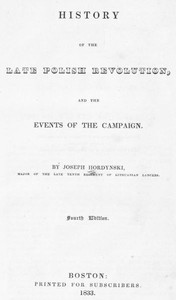
History of the Late Polish Revolution and the Events of the Campaign — Inside the Classic can be approached with a clearer sense of reading commitment from its source measurements: 123,645 words, 8 hr 58 min estimated reading time, and 13 detected text sections.
The text analysis averages about 24.2 words per sentence, while the detected sections provide another way to judge how the source is divided.
Project Gutenberg metadata also associates the work with “Poland -- History -- Revolution, 1830-1832,” connecting these edition facts with the source record’s subject description.
Explore this collection
These alternatives are selected using recorded categories and estimated reading time.
About 523 minutes
World Events
120,145 recorded words. 15 minutes difference from this book's estimate.
View Gutenberg source #31086About 604 minutes
World Events
138,817 recorded words. 66 minutes difference from this book's estimate.
View Gutenberg source #38587About 457 minutes
World Events
104,975 recorded words. 81 minutes difference from this book's estimate.
View Gutenberg source #43124Search stored excerpts and compare books → Choose by your preferences →
Choices use stored catalog measurements. Estimates vary with reading speed. A shared category is a catalog label, not a claim that two books have the same argument or literary quality.
Search reads excerpt text stored with this catalog and links to its associated Gutenberg record. The connection is stored in the site database; this tool does not recheck that every excerpt is word-for-word identical to that external record. Excerpt search does not cover every chapter and does not verify historical publication dates.
Catalog snapshot checked: 2026-09-25. Coverage: 95 public books, 95 available source excerpts.
Read the complete public-domain text at its original source.
Read on Project GutenbergMajor Joseph Hordynski, a veteran of the Tenth Regiment of Lithuanian Lancers, frames his narrative as a corrective to foreign press coverage: 'our land, like most countries struggling for liberty, was surrounded by enemies rather than friends.' His account draws on three sources—his own eyewitness memory, reports from comrades, and official dispatches—and is dedicated to the American people, whom he addresses as 'the great and free nation.' The book opens with a portrait of Kościuszko and a dedication that explicitly links Polish and American revolutionary ideals.
Hordynski repeatedly signals the reliability of his account by naming his sources. He writes from 'my own recollections of events of which I was an eye-witness,' supplemented by 'the reports of my friends and comrades who were present' and 'the official reports of the detached corps.' This threefold method is unusual for a memoir of the period and suggests a deliberate effort to produce a documented history rather than a personal apologia. The author also notes that his version will be 'entirely opposed to the representations given in the public papers,' indicating a polemical intent. Readers should note that the excerpts do not reveal how consistently he applies this method across the full 123,645-word text.
A detailed description of Fortress Modlin illustrates Hordynski's habit of embedding tactical analysis in geographical description. He notes its 'pentagonal form,' its position 'sixteen miles from Warsaw, upon the right bank of the Vistula, at the junction of the Narew,' and the fact that it is 'situated between three rivers.' The fortress's 'commanding elevation' is presented as a key to its defensive strength. Such passages serve a dual purpose: they orient the reader unfamiliar with Polish geography, and they implicitly argue that Polish commanders made rational use of terrain—countering any suggestion that their resistance was futile or reckless.
The excerpts include a full exchange of letters between Marshal Diebitsch and Colonel Leduchowski during the siege of Modlin. Diebitsch's letter employs flattery and an appeal to 'legitimate monarch,' while Leduchowski's reply—given 'in nearly the following terms'—declares he will defend 'to the last drop of my blood.' Hordynski frames this correspondence as evidence that Polish officers acted from honor, not ambition. The inclusion of such documents within a battle narrative suggests that the author intended his history to serve as a legal and moral brief as much as a military record. The excerpts do not reveal whether the letters are quoted verbatim or paraphrased.
Readers should approach Hordynski's text as both a personal memoir and a political document addressed to an American audience. The author's explicit aim—to inform Americans of 'the injustice and outrages' suffered by Poland—shapes every selection of evidence. The excerpts show a writer attentive to detail, but the full work likely contains gaps and biases typical of partisan histories. Comparing his account with other contemporary sources on the November Uprising would be a productive next step.
Reading Hordynski’s account, I kept thinking how war feels less like grand strategy and more like weather—unavoidable, personal. His quiet defiance stayed with me for days. It reminded me of another old memoir, Our Navy in the War — Reading Notes, where the same patience with detail turns duty into something almost tender. Some books just leave their dust on your hands.
Your answers remain private and are stored only in this browser.