About 93 minutes
Texas in the Civil War: A Résumé History — A Reader’s Guide
Modern Nations
21,260 recorded words. 2 minutes difference from this book's estimate.
View Gutenberg source #56709
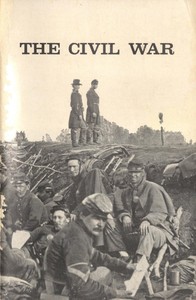
The catalog record for The Civil War — Reading Notes provides practical reading context through 20,764 words, 1 hr 31 min estimated reading time, and 4 detected text sections.
The text analysis averages about 13.8 words per sentence, while the detected sections provide another way to judge how the source is divided.
Project Gutenberg metadata also associates the work with “United States -- History -- Civil War, 1861-1865,” connecting these edition facts with the source record’s subject description.
Explore this collection
These alternatives are selected using recorded categories and estimated reading time.
About 93 minutes
Modern Nations
21,260 recorded words. 2 minutes difference from this book's estimate.
View Gutenberg source #56709About 95 minutes
Modern Nations
21,701 recorded words. 4 minutes difference from this book's estimate.
View Gutenberg source #35122About 96 minutes
Modern Nations
22,071 recorded words. 5 minutes difference from this book's estimate.
View Gutenberg source #24741Search stored excerpts and compare books → Choose by your preferences →
Choices use stored catalog measurements. Estimates vary with reading speed. A shared category is a catalog label, not a claim that two books have the same argument or literary quality.
Search reads excerpt text stored with this catalog and links to its associated Gutenberg record. The connection is stored in the site database; this tool does not recheck that every excerpt is word-for-word identical to that external record. Excerpt search does not cover every chapter and does not verify historical publication dates.
Catalog snapshot checked: 2026-09-25. Coverage: 95 public books, 95 available source excerpts.
Read the complete public-domain text at its original source.
Read on Project GutenbergThe booklet opens with a foreword that explicitly states its purpose: to present in simple language a survey of the eleven most popular aspects of the conflict, intended as a supplement to textbooks. This framing immediately signals a selective, topic-driven approach rather than a chronological narrative. The table of contents and the editorial advisory board—comprising historians and educators—underscore the work's origin as an official centennial publication aimed at students.
The foreword acknowledges space limitations, noting that only a fraction of the war's 6,000 engagements can be covered. This candor sets expectations: the booklet will prioritize major theaters and representative examples. The first substantive excerpt—on naval warfare—illustrates this selectivity. It opens with a broad statement about Federal navies on the Mississippi, then quickly narrows to specific vessels like Charles Ellet's steel rams, described as having "no guns and little beauty" but great speed. The prose balances general claims with concrete details, such as the ram's design by a civilian engineer and its role in opening the Mississippi past Memphis. This pattern of moving from overview to specific case recurs throughout the excerpts.
The naval section demonstrates the booklet's method: it presents a series of discrete, vivid episodes rather than a continuous argument. The Confederate raiders Florida, Alabama, and Shenandoah each receive a paragraph summarizing their captain, number of prizes, and fate. The Alabama's duel with the Kearsarge is noted as occurring "off the coast of France" after two years at sea. The Shenandoah is highlighted for seizing ships two months after the war ended. These details are presented without analysis of broader strategy, leaving the reader to infer the impact of commerce raiding. The section then shifts to the Monitor vs. Virginia battle, describing the Monitor as a "tin can on a shingle" and noting the three-hour draw that made wooden ships obsolete. The prose remains brisk, with statistics (range of 900 yards, four-inch iron plates) and human touches (the Virginia required 30 minutes to turn).
A later excerpt turns to Confederate innovations, particularly the ironclad ram Arkansas, constructed from "wood, railroad rails, wire" in the summer of 1862. This passage exemplifies the booklet's interest in material and engineering specifics. The Arkansas is described as having "the appearance and characteristics of a monster," a phrase that conveys both its improvised nature and its fearsome reputation. The excerpt does not explain the strategic context of the Arkansas's operations on the Mississippi; instead, it treats the vessel as a notable curiosity. This approach—highlighting individual ships, inventors, and battles—reflects the booklet's aim to cover "eleven most popular aspects" rather than provide a unified narrative. Readers encounter a series of snapshots, each self-contained and rich in concrete detail.
The excerpts end with Project Gutenberg's standard licensing and donation information, which is not part of Robertson's original text. However, the transition from the booklet's content to this paratext underscores the work's status as a historical document. The original foreword addressed "thousands of student requests" and included a list of recommended readings after each section—a feature not visible in the excerpts. The closing of the booklet itself likely returned to the centennial commission's mission. For the modern reader, the juxtaposition of 1963 educational goals with 2018 digital republication highlights how the booklet's concise, example-driven style was designed for a specific pedagogical context. The absence of political, economic, or social history, as acknowledged in the foreword, means the naval excerpts stand as representative of the booklet's military-technical focus.
The excerpts reveal that Robertson's booklet does not build a sustained argument but rather presents a curated set of episodes. Each section—whether on the Monitor and Virginia, Confederate raiders, or river ironclads—can be read independently. The prose is efficient, often beginning with a general statement ("The Confederacy was born without a navy") before moving to specific examples. This structure suits the stated purpose of a supplement for students who may dip into individual topics. The recurring emphasis on technical details—ship dimensions, armament, inventors' names—gives the narrative a factual density that rewards careful reading. At the same time, the lack of connective analysis means the reader must supply the broader context from other sources, as the foreword itself recommends.
Readers approaching this booklet should expect a series of tightly focused, fact-rich vignettes rather than a continuous history. The naval excerpts, with their attention to specific ships, commanders, and engineering details, exemplify the work's method. To get the most from the text, consider each section as a starting point for further exploration, using the recommended readings listed after each chapter—a feature not reproduced in the excerpts but integral to the original design.
I kept thinking about how that old booklet quietly untangles a vast war into singular, honest moments—the weight of detail making grief more real, not less. It reminded me of another close reading, this one of France before its own upheaval, where small observations about daily life carry the whole ache of what’s coming. Some books leave a residue, don’t they? The State of Society in France Before the Revolution of 1789 And the Causes Which Led to That Event — Story, Setting & Ideas lingered like that for me—a quiet, sober echo.
Build a private reading journal entry for this title.