About 47 minutes
The Contest in America — A Reader’s Guide
Modern Nations
10,698 recorded words. 1 minutes difference from this book's estimate.
View Gutenberg source #5123
This digital edition of The Mentor: The Revolution, Vol. 1, Num. 43, Serial No. 43 The Story of America in Pictures — A Reader’s Guide is described by source-level measurements including 10,537 words, 46 min estimated reading time, and 7 detected text sections.
The text analysis averages about 20.3 words per sentence, while the detected sections provide another way to judge how the source is divided.
Project Gutenberg metadata also associates the work with “United States -- History -- Revolution, 1775-1783,” connecting these edition facts with the source record’s subject description.
Explore this collection
These alternatives are selected using recorded categories and estimated reading time.
About 47 minutes
Modern Nations
10,698 recorded words. 1 minutes difference from this book's estimate.
View Gutenberg source #5123About 45 minutes
Modern Nations
10,209 recorded words. 1 minutes difference from this book's estimate.
View Gutenberg source #32043About 44 minutes
Modern Nations
9,938 recorded words. 2 minutes difference from this book's estimate.
View Gutenberg source #35581Search stored excerpts and compare books → Choose by your preferences →
Choices use stored catalog measurements. Estimates vary with reading speed. A shared category is a catalog label, not a claim that two books have the same argument or literary quality.
Search reads excerpt text stored with this catalog and links to its associated Gutenberg record. The connection is stored in the site database; this tool does not recheck that every excerpt is word-for-word identical to that external record. Excerpt search does not cover every chapter and does not verify historical publication dates.
Catalog snapshot checked: 2026-09-25. Coverage: 95 public books, 95 available source excerpts.
Read the complete public-domain text at its original source.
Read on Project GutenbergAlbert Bushnell Hart’s The Mentor: The Revolution (1913) opens with a striking rhetorical gambit: words like “Liberty” and “Revolution,” he argues, have been worn smooth by overuse, reduced to pleasant sensations that obscure the violence and upheaval they denote. This framing sets the tone for a work that moves briskly from one iconic episode to the next—Lexington, Bunker Hill, the crossing of the Delaware, the signing of the Declaration—each presented as a discrete picture in a national gallery. The text’s structure is less a continuous narrative than a series of vivid tableaux, anchored by the Mentor Association’s gravures and Hart’s brisk, opinionated commentary.
Hart begins not with a battle but with a meditation on the word “revolution” itself. He describes it as “an overturning, a spinning of the wheel, left to right, and bottom come uppermost,” and immediately ties this abstract image to concrete violence: “big guns booming, troops marching, bullets flying, heads cut off with axes.” The passage is notable for its blunt physicality—arms and legs cut off, ground soaked with blood—and for the wry metaphor of the omelet and broken eggs. This opening establishes a pattern: Hart repeatedly interrupts his own patriotic narrative with cynical asides, as when he imagines textbook pictures of Washington and Howe improbably close on the battlefield. The structure thus oscillates between heroic set pieces and deflating commentary, a tension that persists throughout the volume.
The account of Bunker Hill is the most extended continuous scene in the excerpts. Hart carefully traces the movement of troops: the Americans digging on Breed’s Hill, the British landing at the eastern base, the three assaults. The prose accelerates during the attack—“Steadily up the hill came the level ranks of the Redcoats”—then slows for the famous order to wait for the whites of their eyes. The retreat is described as orderly, and Hart notes the irony that the battle is named for the wrong hill. The sequence ends with a shift to the monument’s cornerstone laying in 1825 and Daniel Webster’s oratory, a jump forward in time that typifies the work’s habit of leaping from event to commemoration. The recurring image of the hill—first as a site of labor, then of slaughter, then of memorial—gives this section a layered structure.
Hart’s treatment of the Trenton campaign emphasizes contingency and human frailty. He sets the scene with the American cause at its lowest ebb, then introduces Colonel Rall’s contemptuous dismissal of entrenchments. The crossing itself is described as “a terrible journey,” though the excerpt cuts off before the battle. More striking is Hart’s inclusion of General Gates’s jealousy and refusal to obey orders—a detail that complicates the heroic narrative. The structure here is a montage: Washington’s plan, the Hessian carousal, Gates’s intrigue, the river crossing. Hart moves between these elements rapidly, creating a sense of multiple forces converging on a single night. The weather and the river function as recurring obstacles, while the betrayal by Gates introduces a note of internal discord that undercuts the unity implied by the title “The Revolution.”
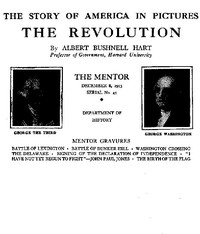
The volume’s subtitle, “The Story of America in Pictures,” is literal: the text is built around six Mentor Gravures listed at the outset—Lexington, Bunker Hill, Washington Crossing the Delaware, Signing the Declaration, John Paul Jones’s “I have not yet begun to fight,” and the Birth of the Flag. Each gravure presumably anchors a section, and Hart’s prose often reads as extended captions. The excerpts show him describing paintings (Henry Mosler’s Washington Crossing the Delaware) and monuments (the Bunker Hill obelisk). This interplay between image and text creates a structure where the narrative halts for ekphrasis. The movement between scenes is thus not only chronological but also medial: from written description to pictorial reference to historical anecdote. Readers should attend to how Hart uses the gravures as pivots, shifting from analysis to spectacle and back.
Hart’s The Mentor is best approached as a guided tour of Revolutionary iconography, where the guide is both enthusiast and skeptic. The brevity of each section—the entire text runs just over 10,000 words—means that no event is treated in depth; instead, the reader is offered a series of sharp impressions. Pay attention to the moments when Hart steps back from the story to comment on its telling, as these asides reveal the editorial hand behind the pictures.
Flipping through Hart’s guide, I kept landing on the same engravings—men mid-charge, smoke curling over ridgelines—until the battles blurred into one long ache. Later, I found myself thinking of that quiet after-action stillness, the pause before casualties are counted. It reminded me, strangely, of the regimental muster rolls in History of the Second Massachusetts Regiment of Infantry: Beverly Ford. — Reading Notes, where the names feel heavier than any headline.
Answer a few questions and save a private reflection on this device.