About 54 minutes
Campaign of Battery D, First Rhode Island Light Artillery — Background and Themes
Modern Nations
12,270 recorded words. 1 minutes difference from this book's estimate.
View Gutenberg source #30822
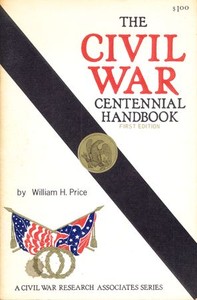
The Civil War Centennial Handbook — Story, Setting & Ideas can be approached with a clearer sense of reading commitment from its source measurements: 12,460 words, 55 min estimated reading time, and 4 detected text sections.
The text analysis averages about 14.6 words per sentence, while the detected sections provide another way to judge how the source is divided.
Project Gutenberg metadata also associates the work with “United States -- History -- Civil War, 1861-1865,” connecting these edition facts with the source record’s subject description.
Explore this collection
These alternatives are selected using recorded categories and estimated reading time.
About 54 minutes
Modern Nations
12,270 recorded words. 1 minutes difference from this book's estimate.
View Gutenberg source #30822About 52 minutes
Modern Nations
11,937 recorded words. 3 minutes difference from this book's estimate.
View Gutenberg source #906About 52 minutes
Modern Nations
11,836 recorded words. 3 minutes difference from this book's estimate.
View Gutenberg source #24653Search stored excerpts and compare books → Choose by your preferences →
Choices use stored catalog measurements. Estimates vary with reading speed. A shared category is a catalog label, not a claim that two books have the same argument or literary quality.
Search reads excerpt text stored with this catalog and links to its associated Gutenberg record. The connection is stored in the site database; this tool does not recheck that every excerpt is word-for-word identical to that external record. Excerpt search does not cover every chapter and does not verify historical publication dates.
Catalog snapshot checked: 2026-09-25. Coverage: 95 public books, 95 available source excerpts.
Read the complete public-domain text at its original source.
Read on Project GutenbergThe Civil War Centennial Handbook (1961) opens with a claim that the war 'began in the 1830's as a cold war'—a framing that appears nowhere in the catalog subject. The book's table of contents reveals a structure driven by visual and technical categories: 'Pictures,' 'Uniforms,' 'Dates and Places,' and a 'Recommended Reading' list. The catalog subject 'United States -- History -- Civil War, 1861-1865' suggests a general history, but the excerpts show a handbook focused on matériel—wagons, pontoon bridges, telegraph wires, and artillery ranges—rather than political or social narrative.
The handbook was published by Prince Lithograph Co. in Arlington, Virginia, and copyrighted 1961, squarely within the Civil War Centennial (1961–1965). Its title page announces a 'First Edition' and a 'Civil War Research Associate Series.' The opening pages include a poem from the Pennsylvania Monument at Vicksburg, suggesting a commemorative, patriotic tone. Yet the catalog subject does not capture the handbook's explicit centennial context or its production as a commercial lithographic product. The excerpts reveal a work that blends factual tables—such as a 'Typical Gunner's Table' for a 12-pounder field gun—with photographic captions and uniform plates, making it a hybrid reference work rather than a continuous history.
The catalog subject implies a broad historical account, but the excerpts emphasize objects and logistics. Sections on 'Transportation and supplies' detail that 'nearly 4,000 wagons traveled with Meade's Army of the Potomac' and that 'Federal engineers with portable pontoon bridges kept the army at Lee's heels.' A table lists maximum effective ranges for artillery pieces, from the 12-pounder Howitzer (1,070 yards) to the 12-pounder Whitworth Rifle (8,800 yards). The text also notes that 'the Union military telegraph corps strung more than 15,000 miles of wire' and that 'balloon observation on the battlefield was made possible by the portable gas generator.' These details align with the handbook's subtitle 'Facts' and its visual emphasis, but the catalog subject does not signal this technological focus.
One of the handbook's largest sections is devoted to uniforms, with separate listings for 'Union regulation uniforms,' 'Union regimental uniforms,' 'Confederate regimental uniforms,' and 'Confederate regulation uniforms.' The excerpts include rank-and-file designations such as 'SERGEANT, CAVALRY, C.S. ARMY' and 'PRIVATE, INFANTRY, C.S. ARMY,' alongside overcoat types. This taxonomic approach to military dress is absent from the catalog subject, which treats the war as a single historical event. The handbook also includes photographs of 'Camp life,' 'Correspondents at the front,' and 'Ships of the line,' suggesting a visual encyclopedia. The catalog subject's generality obscures the handbook's role as a pictorial and technical reference for centennial audiences.
The Civil War Centennial Handbook is best approached as a period artifact of the centennial era, not as a comprehensive history. Its value lies in the specific, often numerical details it preserves—wagon capacities, telegraph mileage, artillery ranges—and in its visual documentation of uniforms and matériel. Readers should treat the catalog subject as a broad entry point, but the handbook itself rewards those interested in the material culture and commemorative framing of the Civil War in 1961.
Years after that handbook first showed me the cheerful precision of a uniform plate, I find myself returning to The Boys of '61 or, Four Years of Fighting, Personal Observations with the Army and Navy — Inside the Classic. One catalogs buttons; the other remembers faces. Together they whisper the same quiet truth—that war’s clutter holds its human ache, if only we care to look slowly.
Save your reaction, strongest insight, and memorable passage.