About 586 minutes
Lectures on the French Revolution — A Closer Reading
Revolutions
134,670 recorded words. 216 minutes difference from this book's estimate.
View Gutenberg source #27488
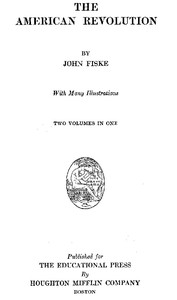
This digital edition of The American Revolution — Reading Notes is described by source-level measurements including 184,449 words, 13 hr 22 min estimated reading time, and 26 detected text sections.
The text analysis averages about 28.9 words per sentence, while the detected sections provide another way to judge how the source is divided.
Project Gutenberg metadata also associates the work with “United States -- History -- Revolution, 1775-1783,” connecting these edition facts with the source record’s subject description.
Explore this collection
These alternatives are selected using recorded categories and estimated reading time.
About 586 minutes
Revolutions
134,670 recorded words. 216 minutes difference from this book's estimate.
View Gutenberg source #27488About 549 minutes
Revolutions
126,213 recorded words. 253 minutes difference from this book's estimate.
View Gutenberg source #3076About 468 minutes
Revolutions
107,437 recorded words. 334 minutes difference from this book's estimate.
View Gutenberg source #39563Search stored excerpts and compare books → Choose by your preferences →
Choices use stored catalog measurements. Estimates vary with reading speed. A shared category is a catalog label, not a claim that two books have the same argument or literary quality.
Search reads excerpt text stored with this catalog and links to its associated Gutenberg record. The connection is stored in the site database; this tool does not recheck that every excerpt is word-for-word identical to that external record. Excerpt search does not cover every chapter and does not verify historical publication dates.
Catalog snapshot checked: 2026-09-25. Coverage: 95 public books, 95 available source excerpts.
Read the complete public-domain text at its original source.
Read on Project GutenbergJohn Fiske's The American Revolution (1891) moves between two distinct registers: the analytical voice of a historian weighing colonial grievances and the dramatic pulse of a military chronicler. In the opening chapter, Fiske dissects the Lords of Trade and the Stamp Act with measured clauses, but as the narrative reaches Saratoga, his sentences tighten around the silver bullet that carried Sir Henry Clinton's message and the emetic that retrieved it. This shift in pace—from parliamentary debate to the physical details of espionage—marks a work that treats political causes and battlefield consequences as equally vivid.
The early chapters proceed in long, periodic sentences that mirror the deliberative pace of eighteenth-century politics. Fiske describes the Lords of Trade, the Albany Congress, and Franklin's federal plan with the gravity of a legal brief. Yet when the narrative reaches 1777, the syntax accelerates. The account of Burgoyne's surrender compresses time: three days of discussion, a Tory's hearsay, a council's debate over honour, and the final signing. Fiske notes that the British army marched out with "the honours of war" and piled arms—a ceremony he renders in clipped, almost reportorial phrases. The rhythm of the prose itself becomes a commentary on the shift from deliberation to action.
Fiske lingers on material details that other historians might omit. The dispatch from Sir Henry Clinton to Burgoyne was written on "a scrap of very thin paper" and encased in an "oval silver bullet" opened with a tiny screw. When the messenger is caught swallowing something, the Americans give him an emetic, retrieve the bullet, read the dispatch, and hang him to an apple-tree. Fiske does not moralize; he simply records the sequence. This forensic attention—to the screw, the emetic, the apple-tree—reveals a writer who understands that history turns on small, tangible objects. The pace here is swift, almost cinematic, a sharp contrast to the earlier chapters' measured exposition.
Fiske devotes a paragraph to the word "convention" itself. Burgoyne, he writes, insisted on the term in imitation of the Convention of Kloster-Seven, by which the Duke of Cumberland "had sought to save his feelings while losing his army." Fiske notes that British historians still use the phrase, but his own tone is dryly ironic. The pacing here is deliberate: he pauses the narrative flow to examine a single word, then resumes with the surrender's aftermath. This technique—slowing down to dissect terminology, then accelerating through events—characterizes Fiske's method throughout. He treats language as part of the historical record, subject to the same scrutiny as troop movements.
Readers will find that Fiske's narrative rewards attention to its shifts in tempo. The early chapters demand patience with parliamentary procedure; the later ones offer set pieces of military drama. The silver bullet, the apple-tree, and the emetic are not mere colour—they are evidence of a historian who believed that the texture of events matters as much as their causes. Approach the book as a work of literary craft as well as historical argument, and its 800-minute length becomes a journey through a writer's evolving voice.
That grey afternoon, rain tapping the windowsill, I kept returning to Fiske’s account of Washington’s grim winter at Valley Forge—how sheer endurance, not brilliance, carried the cause. Later, turning pages absentmindedly, my hand found Lectures on the French Revolution — A Closer Reading, and I wondered if all revolutions are just weather, patience, and the slow wearing away of old certainties.
Save your reaction, strongest insight, and memorable passage.