
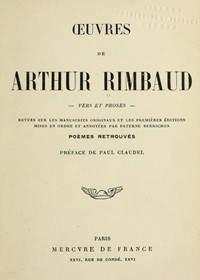
Oeuvres de Arthur Rimbaud: Vers et proses by Arthur Rimbaud
This isn't a book with a plot in the usual sense. It's the life's work of a literary comet. The 'story' is the arc of Rimbaud's mind, captured in two distinct acts.
The Story
First, you get the Vers (Poems). This is the work of a teenage Rimbaud, roughly from ages 15 to 20. He arrives in Paris, befriends (and famously clashes with) the poet Paul Verlaine, and proceeds to set French poetry on fire. Poems like 'Le Bateau ivre' ('The Drunken Boat') are chaotic, vivid trips. He doesn't just describe things; he makes you feel the color of vowels and the disorder of the senses. Then, around 1873, he writes Une Saison en Enfer ('A Season in Hell'), a blistering prose poem that feels like a self-diagnosis and a farewell.
Act Two is the Proses, mainly Les Illuminations. These are cryptic, dazzling fragments—part dream journal, part cityscape painting. After this, around age 21, Rimbaud stopped writing literature completely. He spent the rest of his short life traveling, trading, and exploring in Africa and the Middle East. The book ends with his silence.
Why You Should Read It
You read Rimbaud not for a cozy story, but for the shock of pure, unedited imagination. His best lines hit you like a sudden, perfect chord. He gave permission to every artist after him to break the rules, to chase a wilder kind of truth. For me, the most compelling part is the contrast. The youthful poems are all explosive energy, while the later prose feels like the cooling, brilliant shards of that same mind. Reading it all together, you're tracing the path of a meteor: the bright, burning arc and the sudden drop into darkness.
Final Verdict
This collection is perfect for anyone who loves poetry that feels dangerous, or for readers curious about the myth of the 'cursed poet.' It's also great for creative people who've ever felt burnt out or wondered about the price of their own vision. It's not an easy, relaxing read—it demands your attention—but it's a short, powerful plunge into a mind that changed everything. Just be ready for some beautiful, unsettling weather.
This work has been identified as being free of known copyright restrictions. It is available for public use and education.
Richard Thompson
6 months agoThe clarity of the introduction set high expectations, and the way it handles controversial points with balance is quite professional. I'll be recommending this to my students and colleagues alike.
Thomas Smith
1 year agoAs someone working in this industry, I found the insights very accurate.
David Johnson
2 years agoComparing this to other titles in the same genre, the chapter on advanced strategies offers insights I haven't seen elsewhere. Definitely a five-star contribution to the field.



Donald Williams
9 months agoComparing this to other titles in the same genre, the author manages to bridge the gap between theory and practice effectively. This is a solid reference for both beginners and experts.