
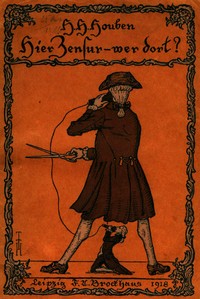
Hier Zensur - wer dort? Antworten von gestern auf Fragen von heute by H. H. Houben
Published in 1926, Hier Zensur - wer dort? is a collection of historical sketches by journalist Heinrich Hubert Houben. He doesn't tell one continuous story. Instead, he opens different windows into the past, each showing a moment where power clashed with the written word.
The Story
Houben acts like a detective of literary history. He digs into archives and old records to find cases of censorship from the 18th and 19th centuries, primarily in German states. We meet booksellers whose shops are searched, playwrights whose works are banned from the stage, and journalists who face fines or imprisonment. Some stories are about big names, like the struggles around publishing Goethe's work. Others are about forgotten writers who ran afoul of a local duke or a nervous church official. The 'plot' is the constant, repeating conflict: an individual has an idea, puts it on paper, and then an authority figure tries to erase it. Houben presents these cases not as dry facts, but as human dramas of frustration, courage, and sometimes absurdity.
Why You Should Read It
This book grabbed me because it's so quietly powerful. Houben isn't shouting from a soapbox. By showing you the mechanisms of past censorship—the secret police reports, the economic pressures on publishers, the vague laws—he makes you recognize similar patterns. Reading it in the 21st century, you start swapping out 'royal decree' for 'terms of service' and 'state censor' for 'content moderator.' The questions become personal: What do I hesitate to say or write? What invisible boundaries do I respect without even thinking? It’s a history book that turns into a mirror. Houben’s greatest trick is letting these old stories speak for themselves, trusting you to make the connection to your own time.
Final Verdict
This is a perfect read for anyone interested in the long, messy history of free expression, especially if you prefer real stories over pure theory. It's for readers who enjoy connecting historical dots and for writers who understand the weight of words. While the context is specifically German, the themes are universal. Be prepared for an older writing style and a lot of historical names, but the core ideas are incredibly clear and relevant. Think of it less as a textbook and more as a toolkit for understanding the eternal tug-of-war between voice and control.
This digital edition is based on a public domain text. Distribute this work to help spread literacy.
Noah Thompson
10 months agoBased on the summary, I decided to read it and the content flows smoothly from one chapter to the next. Exceeded all my expectations.
Linda Taylor
1 year agoThis book was worth my time since it challenges the reader's perspective in an intellectual way. A true masterpiece.
Noah Nguyen
1 year agoFinally a version with clear text and no errors.
Kevin Williams
9 months agoFrom the very first page, the storytelling feels authentic and emotionally grounded. A valuable addition to my collection.



George Johnson
7 months agoI was skeptical about the depth of this book at first, but the quality of the diagrams and illustrations (if applicable) is top-notch. I appreciate the effort that went into this curation.