
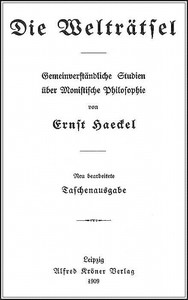
Die Welträtsel: Gemeinverständliche Studien über Monistische Philosophie by Haeckel
This isn't a novel with characters and a plot. The 'story' here is an argument—a grand, sweeping one. Haeckel, a brilliant and fiercely dedicated biologist, believed science had solved enough mysteries to offer a complete picture of reality. He called this view 'Monism': the idea that everything in the universe, including life, mind, and matter, is made of the same stuff and follows the same physical laws.
The Story
Haeckel builds his case step by step. He starts with what we know from biology and evolution, explaining how complex life arises naturally. Then, he applies that same scientific thinking to the biggest questions: Where did the universe come from? What is consciousness? What happens when we die? His answers leave no room for supernatural explanations. He argues that the soul is a function of the brain, that a creator god is an unnecessary idea, and that ethics should come from our social nature, not from religious doctrine. The entire book is a systematic effort to replace religious and dualistic worldviews with a unified scientific one.
Why You Should Read It
You should read this not to agree with every conclusion (many are outdated), but to feel the raw energy of a revolutionary idea. Haeckel writes with absolute conviction. He's not a cold observer; he's a campaigner for reason, and his passion leaps off the page. It’s fascinating to see which of his predictions came true and which seem naive now. More than anything, this book is a historical landmark. It shows us the moment when science, bursting with new discoveries like evolution, felt bold enough to claim it could answer all of life's riddles.
Final Verdict
This book is perfect for curious readers who enjoy the history of ideas. If you've ever read about the Scopes 'Monkey Trial' or debates about science vs. religion and wanted to go to the source, this is a key text. It's also great for anyone interested in how scientific optimism shaped the modern world. Be prepared for dense sections and concepts that science has since refined, but read it as a powerful artifact from the front lines of a war of worldviews. It’s a challenging, provocative, and utterly fascinating piece of intellectual history.
This text is dedicated to the public domain. Thank you for supporting open literature.
Michael Wilson
8 months agoOne of the most comprehensive guides I've read this year.
William Miller
11 months agoThe layout of the digital version made it easy to start immediately, the chapter on advanced strategies offers insights I haven't seen elsewhere. This is a solid reference for both beginners and experts.
Linda Perez
11 months agoHaving explored several resources on this, I find that the nuanced approach to the central theme was better than I expected. This should be on the reading list of every serious professional.
Matthew Taylor
9 months agoA sophisticated analysis that fills a gap in the literature.


Jessica Jones
7 months agoThe citations provided are a goldmine for further academic study.