
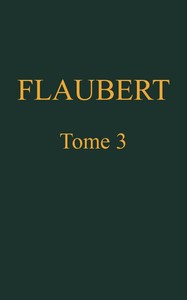
Œuvres complètes de Gustave Flaubert, tome 3: L'éducation sentimentale, v. 1
I’ll be honest, Flaubert isn’t always an easy hang, but this first part of Sentimental Education has this weird, magnetic pull. It’s less about a thrilling plot and more about soaking in a specific time, place, and state of mind.
The Story
The year is 1848. Frédéric Moreau, a young man from the provinces, comes to Paris to study law. He’s instantly swept up in the chaotic energy of a city rebuilding after revolution. In a single day, he meets two people who will define his next few years: Charles Deslauriers, his fiercely ambitious but poor best friend, and Madame Marie Arnoux, the wife of an art dealer. Frédéric falls for Marie with a quiet, desperate intensity that becomes the backdrop for everything else. The rest of the volume follows Frédéric as he drifts. He tries painting, gets involved in vague political circles with his friend, spends money, attends parties, and makes endless plans that never quite happen. His life is a series of almosts—almost an artist, almost a revolutionary, almost Marie’s lover. The central question isn't 'what will he do?' but 'will he ever actually do anything?'
Why You Should Read It
Here’s the thing: Frédéric drove me crazy. He’s passive, indecisive, and often his own worst enemy. But Flaubert writes him with such clear-eyed honesty that you start to see bits of yourself in his failings. Haven’t we all been paralyzed by choice or idealized someone from afar? The book is a brilliant, sometimes satirical look at youthful ambition and how it curdles into daydreams. It’s also a stunning portrait of 1840s Paris. You feel the grime of the streets, the heat of the political arguments in cafes, and the glittering emptiness of high-society salons. Flaubert doesn’t judge the era; he just shows it to you, warts and all, through the eyes of a young man who doesn’t know what to make of any of it.
Final Verdict
This isn't a book for someone looking for a fast-paced adventure. It’s for readers who love character studies and immersive historical settings. If you enjoyed the aimless charm of The Great Gatsby’s party scenes or the sharp social observations of Jane Austen, but set against the backdrop of political upheaval, you’ll find a lot to love here. Perfect for history buffs who like their history personal, or for anyone who’s ever looked back on their youth with a mix of nostalgia and cringe.
This work has been identified as being free of known copyright restrictions. You can copy, modify, and distribute it freely.
John Jones
1 year agoGiven the current trends in this field, it manages to maintain a consistent flow even when discussing difficult topics. I'm glad I chose this over the other alternatives.
Donna Thomas
5 months agoMy professor recommended this, and I see why.
Betty Wright
1 year agoNot bad at all.
Richard Brown
6 months agoThis book was worth my time since it challenges the reader's perspective in an intellectual way. A valuable addition to my collection.






Ashley Lopez
1 year agoLooking at the bibliography alone, the breakdown of complex theories into digestible segments is masterfully done. A perfect balance of theory and practical advice.