
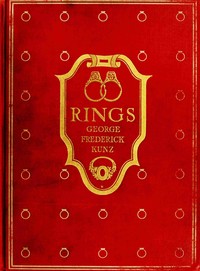
Rings for the finger : from the earliest known times to the present, with full…
Let's be clear: 'Rings for the Finger' is not a novel. There's no plot in the traditional sense. But it has a fantastic journey. Think of it as the world's most detailed, fascinating scavenger hunt, led by an obsessed expert. George Frederick Kunz takes you by the hand and walks you through the entire history of human civilization, using the ring as your map.
The Story
The 'story' is the ring's evolution. Kunz starts in the ancient world, showing us rings made of bone and shell. He moves through Egypt, Greece, and Rome, where rings became official seals and status symbols. The journey continues through the Middle Ages, where rings held religious relics or poison (for dramatic exits). He covers the Renaissance, the Georgian and Victorian eras, right up to his own time in the early 1900s. Each chapter is like opening a little jewelry box from a different century. You see how styles changed, what materials were used (from iron to gold to celluloid!), and most importantly, what people believed these objects did. Was it a love token, a legal signature, a magical protection, or a family heirloom? Kunz answers all of this with examples from archaeology, literature, and his own vast experience.
Why You Should Read It
I picked this up thinking it would be a pretty reference book. I was wrong. It's a mirror. Kunz shows us that rings have always been about human connection, memory, and identity. Reading about a Roman betrothal ring or a medieval 'memento mori' ring (designed to remind the wearer of death) feels incredibly intimate. It makes you realize that the impulse to mark a moment on our bodies is ancient and universal. The book is packed with wild anecdotes and beautiful illustrations, so it never feels like a lecture. Kunz's passion is contagious. You finish a chapter and immediately want to go examine every ring in a museum—or in your own jewelry drawer.
Final Verdict
This book is a hidden gem (pun intended). It's perfect for history buffs who want a unique angle, for jewelry lovers curious about the stories behind the shine, and for anyone who enjoys 'object history'—understanding culture through everyday things. If you liked 'A History of the World in 100 Objects,' you'll love this deep dive into one object. It's not a quick read; it's a book to savor in sections. But it will absolutely change the way you look at a simple band of metal forever. You'll never see a ring as just decoration again.
The copyright for this book has expired, making it public property. Access is open to everyone around the world.
Carol Martinez
1 year agoI was skeptical at first, but the arguments are well-supported by credible references. A true masterpiece.







Carol Harris
1 year agoBeautifully written.