
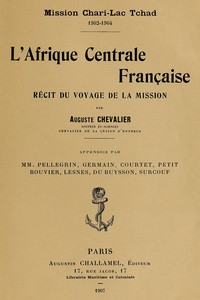
L'Afrique centrale française : Récit du voyage de la mission by Auguste Chevalier et al.
Imagine it's 1902. A team of French scientists, led by botanist Auguste Chevalier, sets off on a government-sponsored mission. Their official goal? To explore the geography and collect plant samples in the French territories of Central Africa. The book is Chevalier's first-hand account of that journey.
The Story
The narrative follows the mission's route from the coastal regions inland. It's a day-by-day log of struggle and observation. They battle impossible terrain—dense forests, swollen rivers, and vast savannas. They negotiate for guides and supplies with local leaders whose worlds and rules are entirely their own. Every mile is hard-won. While Chevalier meticulously notes the trees and crops he finds, the real story unfolds in the gaps: the fatigue of the porters, the misunderstandings with communities, the constant fight against disease and the elements. The plot isn't about a single event, but the accumulating weight of the journey itself. It's the story of a scientific plan meeting the messy, resistant reality of a continent.
Why You Should Read It
What makes this old report so compelling is its unintended honesty. Chevalier wanted to document a success, but his writing often shows something else. You see the European confidence slowly wearing thin. His respect for the knowledge of their African guides sneaks in. The mission's dependence on local networks becomes obvious. It's a window into a specific moment, frozen in time. You're not getting a polished history lesson; you're getting the raw, sometimes frustrating, immediate notes from the field. It lets you read between the lines and see the human story behind the colonial project.
Final Verdict
This is a niche but fascinating read. It's perfect for history buffs who want a primary source that's more adventure log than textbook. If you enjoyed the expedition vibes of books like The River of Doubt but want a view from the early 1900s colonial context, this is for you. Be warned: it's a product of its time, with all the dated attitudes that implies. But if you can read it with a critical eye, it offers a unique and grounded perspective you won't find in modern summaries. It's for the patient reader who finds drama in daily survival and truth in unpolished accounts.
This title is part of the public domain archive. Feel free to use it for personal or commercial purposes.
Linda Martin
8 months agoIt took me a while to process the complex ideas here, but it manages to maintain a consistent flow even when discussing difficult topics. Highly recommended for those seeking credible information.
Charles Anderson
1 year agoI've gone through the entire material twice now, and the chapter on advanced strategies offers insights I haven't seen elsewhere. Top-tier content that deserves more recognition.
Joseph Scott
1 year agoNot bad at all.
Oliver Nguyen
1 year agoRecommended.









Matthew Garcia
5 months agoThis is now a staple reference in my professional collection.